Should buses which have been constructed not to exceed the speed of 100 km/h, be fitted with a speed limiter device?
No.
Yes.
Question 2
The minimum thickness of the tyre tread of buses is:
1,5 mm.
1 mm.
2 mm.
Question 3
Why are you not permitted to move with your engine off, especially when your vehicle has air brakes?
Because from the continuous use of the braking system, you may cause an early wear of the clutch.
Because the vehicle will be ungoverned.
Because from the continuous use of the braking system, you run the risk of being left without brakes.
Question 4
What is the maximum permissible speed limit for buses outside motorways, expressways and residential areas, when this is not specified by special traffic signs?
80 km/h.
100 km/h.
90 km/h.
Question 5
When a car is moving on a curve, which wheels cover the longest distance?
Rear wheels.
Internal wheels.
External wheels.
Question 6
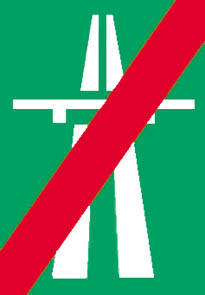
What does this traffic sign mean?
End of expressway.
End of no through road.
End of motorway.
Question 7
Must city buses have a speed limiter device pursuant to directive 92/6/EU:
No.
Yes.
Question 8
According to the legislation the useful load of a bus is:
The sum of the tare weight and load.
The maximum permissible weight less the tare weight.
The gross weight less the load.
Question 9
The maximum permissible loading of a road by a non-steering shaft (either driving or not), for domestic transports, is:
7.500 kg.
7.000 kg.
8.000 kg.
Question 10
In a suspension system with air, what is the use of the high pressure circuit:
It supplies air to the servo-mechanisms of the vehicle.
It maintains the pressure in the air springs steady.
It supplies additional air to, and increases the pressure in the air springs, when the car is being loaded, so as to maintain it steady.
Time 15'
Επιβεβαίωση
Next
×
We're here to help
We use cookies to ensure that we give you the best experience on our website. If you continue to use this site we will assume that you are happy with it.OK