Which is the maximum permissible speed limit for buses in expressways, when this is not specified by special traffic signs?
100 km/h.
80 km/h.
90 km/h.
Question 2
In a suspension system with air, what is the use of the high pressure circuit:
It supplies air to the servo-mechanisms of the vehicle.
It maintains the pressure in the air springs steady.
It supplies additional air to, and increases the pressure in the air springs, when the car is being loaded, so as to maintain it steady.
Question 3
The non-skid chains are fitted to?
The wheels of the driving shaft.
One wheel of the steering shaft and the wheel of the driving shaft diametrically opposite to that.
The wheels of the steering shaft.
Question 4
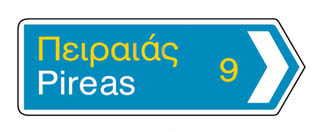
What does this traffic sign mean?
Direction towards a place in the form of an arrow.
Warning of compulsory course.
Direction towards a place of great touristic or archaeological interest in the form of an arrow.
Question 5
What does this traffic sign mean?
Dangerous right bend ahead.
Compulsory passage only from the right side of the traffic island or obstacle.
Turn right ahead.
Question 6
What does this traffic sign mean?
Two dangerous converse or successive (continuous) bends, the first of which is left.
Slippery road.
Two dangerous converse or successive (continuous) bends, the first of which is right.
Question 7
Which is the function of the silencer of the exhaust pipe:
To decrease the speed of exhaust gases outlet so as to reduce fuel consumption.
To decrease the speed of exhaust gases outlet so as to reduce noise.
To decrease the speed of exhaust gases outlet so as to warm up the interior of the vehicle.
Question 8
At vehicle braking under normal circumstances, on what does braking distance depend mainly?
The speed of the vehicle.
The kind of the braking system.
The pressure you exert on the footbrake pedal.
Question 9
The maximum permissible weight of a three-axle bus that performs domestic transports is:
28.000 kg.
24.000 kg.
26.000 kg.
Question 10
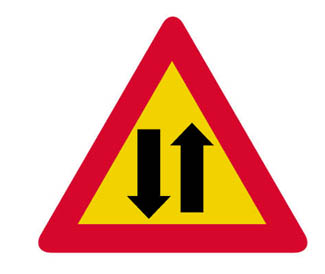
What does this traffic sign mean?
Priority of the oncoming traffic.
Priority over the oncoming traffic.
Forewarning of a two-way street.
Time 15'
Επιβεβαίωση
Next
×
We're here to help
We use cookies to ensure that we give you the best experience on our website. If you continue to use this site we will assume that you are happy with it.OK