Question 1
Which driving way saves fuel?
-
Driving prudently and releasing the accelerator in good time.
-
Driving with the maximum number of revolutions.
-
Driving with the minimum number of revolutions.
Question 2
What affects the extent of the centrifugal force on a bend?
-
The speed.
-
The air created during the movement of the vehicle.
Question 3
When you meet this traffic sign:
-
You should give priority at the next crossroads.
-
At the next crossroads you will have the right of way.
Question 4
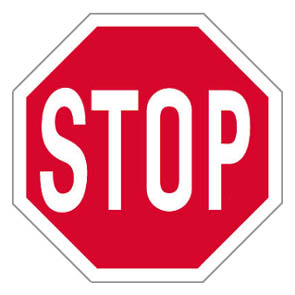
What should you do if you saw this traffic sign before an intersection?
-
Stop at the sign and give priority.
-
Stop at the stop line or, if there is no such line, at the imaginary extension line of the pavement so that you have full visibility of the intersection, and give priority.
-
Stop only if another vehicle is coming vertically.
Question 5
What should you do if you saw this traffic sign?
-
Slow down, check whether a train is approaching and continue your course.
-
Stop at the special line or, in case there is no such line, at the traffic sign and do not start unless you have made sure that no train is approaching.
-
Continue your course without delay.
Question 6
Which vehicle is allowed to move off first?
-
Vehicle 1.
-
Vehicle 2.
-
Vehicle 3.
Question 7
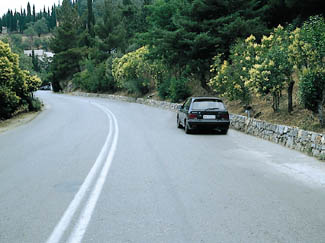
There is no yellow line on the pavement. Is the passenger car properly parked?
Question 8
You can recognise a slow-down lane from:
-
The special horizontal line.
-
The traffic sign giving priority.
Question 9
In a motorway or expressway with three traffic lanes per direction you are towing a caravan:
-
You cannot use the left lane to overtake.
-
You can use the left lane to overtake.
Question 10
Your car has a good acceleration, however, in a few metres you notice a continuous line between the directions:
-
You can overtake.
-
You must not overtake.
Question 11
What does this traffic sign mean?
-
Direction of vehicles for parking near an Underground station.
-
Direction towards an Underground station.
-
Direction of vehicles towards a place of permissible parking.
Question 12
In which cases should you ease down the speed of your vehicle?
-
On bends.
-
When overtaking another vehicle you are next to it.
-
When passing in front of parking lots in general.
Question 13
What does this traffic sign mean?
-
Turn right ahead.
-
Compulsory passage only from the right side of the traffic island or obstacle.
-
Downhill stretch of a road on the right.
Question 14
In case of the offence of “escape” you run the risk of being punished by:
-
A fine of 50,000 drachmas.
-
Imprisonment and disqualification.
Question 15
Driving activity consists of the following:
-
Perception, analysis, decision, action.
-
Decision, perception, analysis, action.
-
Action, perception, analysis, decision.
Question 16
What does this traffic sign mean?
-
Place for caravans.
-
Place for camping and caravans.
-
Mountain refuge.
Question 17
The noise caused by motor vehicles:
-
is reduced when you speed up
-
is reduced if the engine has been cleaned
-
can be reduced by proper driving, avoiding braking and speeding up sharply
Question 18
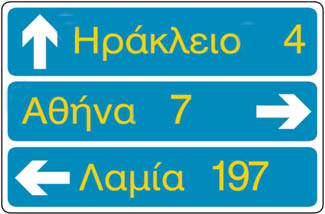
What should you do in order to head for Athens if you saw this traffic sign?
-
Turn right ahead.
-
Go straight.
-
Turn left ahead.
Question 19
What does the green traffic light in the shape of a vertical arrow showing downwards mean?
-
You are allowed to drive in all lanes of the road.
-
You are allowed to drive in the lane over which the arrow is.
-
You are not allowed to drive in the lane over which the arrow is.
Question 21
You are driving and you must stop. At what distance must you stop the latest?
-
Twice the distance of visibility field.
-
At the distance of visibility field.
Question 22
The triode catalytic converters reduce the emission of carbon monoxide, oxide of nitrogen and hydrocarbons by up to:
Question 23
If the fuse of an electrical circuit (e.g. lights) of your car is blown, what should you do?
-
Replace it with a new one of less ampere.
-
Replace it with a new one of more ampere.
-
Replace it with a new one of the same ampere.
Question 24
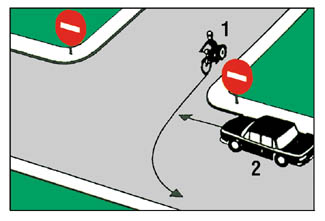
Which vehicle has priority?
-
Vehicle 1.
-
Vehicle 2.
-
None; the drivers must agree between themselves.
Question 25
The traffic light is red. Which vehicle must wait?
-
Both vehicles.
-
Vehicle 1.
-
Vehicle 2.
Question 26
What does this traffic sign mean?
-
Two dangerous converse or successive bends, the first of which is right.
-
Two dangerous converse or successive bends, the first of which is left.
-
Right turn is forbidden.
Question 27
Your vehicle is 4.5 m long. Does this traffic sign prohibit you from entering?
Question 28
What does this traffic sign mean?
-
No entry to motor vehicles except for two-wheeled motorcycles.
-
No entry to motorcycles.
-
Road only for two-wheeled vehicles.
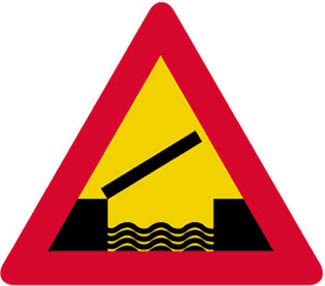
Question 29
What does this traffic sign mean?
-
The road leads to a dock.
-
Caution! Bridge without bars.
-
Mobile bridge.
Question 30
Whom should you allow to drive your vehicle?
-
A holder of a driving licence which entitles them to drive a vehicle of the same category with yours.
-
A person above the age of 18 who knows how to drive or is a learner driver.
-
Nobody.