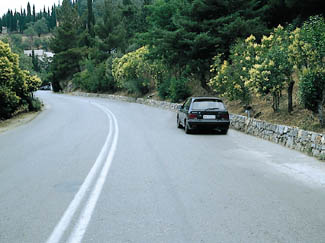
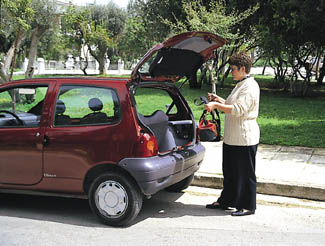
1. The parking of this vehicle is:
2. Has the private car, which has stopped on the right side of the road, violated the law?
3. If you car has stopped thus, should the side lights be on?
-
It is optional.
-
It is compulsory.
-
It is recommended.
4. On which part of the road is parking allowed?
-
Between the traffic signs.
-
On a part other than that defined by the traffic signs.
5. No traffic signs prohibit you from parking. Are you allowed to park thus?
6. There is no yellow line on the pavement. Is the passenger car properly parked?
7. Is this car properly parked?
8. You intend to park on the road of the picture one day of February. Which side of the road will you choose?
-
The left one.
-
The right one.
9. At which point are you permitted to park?
-
At a distance of over 12 m from the bus-stop.
-
At a distance of over 5 m from the bus-stop.
-
At any position other than in front of the bus-shelter
10. The distance of a passenger car from the traffic lights of the picture is 15 m. Is parking allowed at the point the car is?
11. When you leave your car along the pavement, the time needed for loading or unloading your luggage is:
-
A waiting time.
-
A parking time.
12. You intend to park in the road of the picture on one day in July. Which side of the road should you choose?
-
The left one.
-
The right one.
13. Waiting at this point is:
-
Acceptable if short.
-
Not recommended.
-
Dangerous.
14. Why are you not allowed to stop on the right part of the street?
-
Because there is a traffic sign that prohibits waiting and parking as well as a continuous yellow line at the edge of the street.
-
Because it is a two-way street.
15. Are you allowed to park along this pavement in the month of April?
16. In an one-way street, if the width of the street is sufficient, can you park on the left as well?
17. Are you allowed to park just on the right of the traffic sign in an array (vertically to the pavement), and why?
-
No, because parking is forbidden at a distance of 10 m from this sign.
-
Yes, because parking is forbidden after 10 m from this sign.
18. You have immobilised your vehicle in front of a post office to buy stamps:
-
This is an intended waiting.
-
This is an intended parking.
19. Waiting at this point is:
-
Acceptable if short.
-
Not recommended.
-
Dangerous.
20. Waiting at this point is:
-
Acceptable, if short.
-
Dangerous.
-
Not recommended.
21. Your reaction time is 1 second. What distance will your vehicle cover, according to the empirical rule, if running at a speed of 100 km/h during your reaction time?
22. You are approaching at a speed of 40 km/h an intersection which has traffic lights. About 40 m before the STOP line the green traffic light changes to amber. What should you do?
-
Stop.
-
Continue your course.
23. What should you be very careful about as a driver of a passenger car with a fully loaded trailer which does not have its own brakes?
-
The acceleration ability will increase.
-
The stopping distance will be shorter.
-
The braking distance will be longer.
24. You are driving in a country road at night having the dipped headlights on. At what distance should you be able to stop the latest?
-
Twice the length of the beam of the dipped headlights.
-
Equal to the length of the beam of the dipped headlights.
25. You are driving and you must stop. At what distance must you stop the latest?
-
Twice the distance of visibility field.
-
At the distance of visibility field.
26. Reaction time varies according to:
-
Condition of your vehicle.
-
External conditions (fog, etc.).
-
Your physical state (fatigue, drunkenness, stress, irritation).
27. Reaction time varies according to:
-
External conditions (fog, etc.).
-
Your age.
-
Condition of your vehicle.
28. How many times longer will braking distance become under the same circumstances, if you double speed?
29. If you wish to stop here for a few minutes, are you allowed to do it?
30. No traffic sign is prohibiting you from parking. Can you park thus?