1. A two-wheeled moped which is moving at a low speed pulls in suddenly ahead of you in a road with heavy traffic:
-
You should let it pass.
-
You should prevent it going ahead of you.
-
You should sound the horn.
2. What should you have in mind when your vehicle is approaching children?
-
A very quick and correct reaction of the children in case of a danger.
-
Children’s behaviour which is in accordance with the Highway Code.
-
An imprudent behaviour of the children.
3. When should you switch on the hazard lights as a driver of a passenger car?
-
When the vehicle is parking in a double row.
-
When the vehicle stays in a position where it cannot be recognised as an immovable obstacle in good time.
4. Your vehicle has broken down in a country road. What should you be careful about during the towage?
-
Enter the motorway from the next entry, because in it you can drive at a steady speed.
-
During the towage switch on the hazard lights of both vehicles.
5. A drove of animals is passing ahead of your vehicle. What should you have in mind?
-
Other individual animals should be disregarded.
-
Other individual animals may follow the drove.
6. In a country road where it is raining and it is dark, vehicles are coming from the opposite direction having their dipped headlights on. What should you have in mind?
-
That if you switch on the full beam headlights you may avoid a possible dazzle.
-
That if the windscreen is wet you may be dazzled.
7. Which factors may create dangers for road traffic?
-
Damaged bonnet of a car.
-
Very highly adjusted main beam headlights.
8. Which users of the road network should you be careful of?
-
Invalids, children and pedestrians who need help.
-
Other passenger vehicles that tow trailers.
-
Large vehicles.
9. What does “defensive driving” mean?
-
Being careful of others’ possible mistakes.
-
Stopping at every crossroads.
-
Always insisting on your right.
10. Why are drivers not permitted to drive very slowly without a serious reason?
-
Because traffic flow would be hindered without a serious reason.
-
Because the danger of a crash (from behind) would increase.
11. In which of the following cases are you allowed to use the fog lights?
-
When there is a fog or snowfall or torrential rain.
-
In any case where visibility is limited.
-
When passing through tunnels.
12. How can one show that students get on or off a bus?
-
By switching on the dipped headlights.
-
By sounding the horn.
-
By switching on the hazard warning lights.
13. What should you do if the crash with wild animals is inevitable?
-
In any case make something to avoid the crash.
-
Brake, hold the steering-wheel firmly and try to maintain your course.
14. At intersections where there are pedestrian crossings and traffic is not regulated by a traffic policeman or traffic lights, who has priority?
-
Vehicles.
-
Nobody. Both the drivers and pedestrians should determine their movement on their own responsibility.
-
Pedestrians.
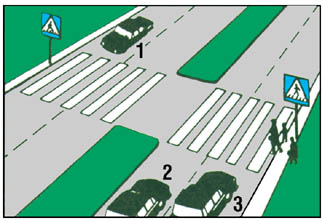
15. Which vehicles must wait for the pedestrians to pass safely?
-
Vehicles 2 and 3.
-
Vehicles 1, 2 and 3.
-
Vehicles 1 and 3.
16. In which case are you allowed to stop preceding military columns or religious processions?
-
Under no circumstances.
-
Only when the columns or processions are moving around squares or roundabouts.
-
Only when you are going to turn right or left.
17. As you are being prepared to overtake, you notice the light of a moped through the exterior mirror:
-
You should speed up before the moped reaches you.
-
You should wait for the moped to pass first and then you should overtake.
18. Half of the road is closed due to a worksite. Two vehicles are coming simultaneously to the worksite from opposite directions. Which vehicle must wait?
-
The vehicle that is moving in the lane where the obstacle is.
-
The smaller vehicle.
-
The wider vehicle.
19. Should you switch on the indicator when you wish to change direction, even if there is no other road user around you?
20. What should you do as a driver of a passenger car, when allowing children to get on and off the car?
-
Allow the children to get on and off only from the side of the pavement.
-
Allow the children to choose from which side they will get on and off.
21. Should you facilitate the passage of an emergency vehicle?
22. People are waiting at a pedestrian crossing without having the obvious intention to cross it. You:
-
Must slow down and, if necessary, stop.
-
Must sound the horn.
-
Must stop.
23. You should give way to emergency vehicles:
-
Only when they use special sound or light warnings.
-
Always.
24. You are approaching a school. The students are leaving the school building. What should you have in mind?
-
That all students behave in accordance with the regulations of the highway code.
-
That students may run out carelessly to the road.
25. When you are moving in a street outside a residential area which is not sufficiently lit, in which cases are you allowed to use the full beam headlights of the vehicle:
-
When a vehicle is ahead at a small distance.
-
When another vehicle is approaching from the opposite direction.
-
When no other vehicle is approaching from the opposite direction and no vehicle is ahead at a small distance.
26. In which cases is horn sounding allowed in cities?
-
Under no circumstances.
-
In cases of emergency for preventing an accident and when you carry persons who are in danger or need medical first aid.
-
When you intend to overtake another vehicle.
27. As you are driving you see a pedestrian who carries a white stick. He/she is possibly:
-
Blind.
-
A person with walking difficulties.
-
Deaf.
28. At a crossroads where the traffic light is green and another vehicle or pedestrian is still moving in accordance with the previous traffic light, which is your obligation?
-
You have no obligation.
-
You must give way.
-
You must stop your vehicle.
29. If you notice that a vehicle from the opposite direction is coming on you due to a break-down or other reason, how should you react?
-
Try by moving to the right if possible, to come out of the track of the vehicle, sounding the horn continually and switching on your lights.
-
Break harshly and sound the horn continually flashing your lights, if it is night.
-
Break harshly.
30. In residential areas at night which lights of your vehicle, when this is moving, must be on?
-
Dipped headlights.
-
Side lights.
-
Full beam headlights.