1. When the brake lights of your vehicle do not work, how should you inform the person that follows of your intention to park?
-
By using the reverse lights.
-
By bending the arm downwards.
-
By bending the arm upwards.
2. When in a works area in the motor-way there are white and yellow lines together, you should obey:
-
Only the white lines.
-
Both white and yellow lines.
-
Only the yellow lines.
3. Which vehicles must have seat belts at the front seats?
-
All passenger cars.
-
All passenger cars and lorries.
-
All passenger cars and lorries with a maximum permissible weight of up to 3,500 kg.
4. Your vehicle is 4.5 m long. Does this traffic sign prohibit you from entering?
5. What should a driver be careful about when using a mirror of a passenger vehicle?
-
The mirrors must be adjusted according to the individual driver’s needs.
-
The interior mirror gives always full visibility to the right.
6. The blind spot is an area:
-
Not visible through an oblique glance over the shoulders.
-
Not seen in the mirrors from the driver’s seat.
-
Seen in the mirrors.
7. To sit on a driver’s seat correctly:
-
You must be able to rest your wrists on the upper part of the steering-wheel and to press the clutch fully.
-
You must be able to rest your hands on the dashboard.
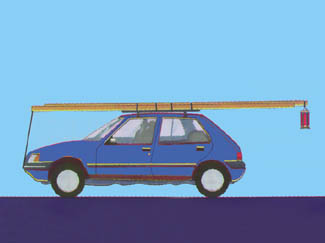
8. Is a bulky object not allowed to jut out backwards more than 30% of the vehicle’s length without a special permit?
9. In order to get on your vehicle?
-
Turn your back to the traffic of your direction.
-
Face the traffic of your direction.
10. When changing lane, in order to check behind properly:
-
Mirrors suffice.
-
Look only through the exterior mirror.
-
Check through the mirrors and turn your head to the side where you are pulling in.
11. The rubbers of the windscreen wipers should be replaced:
-
When they are worn and at least once per year, preferably before winter.
-
Preferably in the summer.
12. For your child’s safety, you can use according to their height, weight and age:
-
Child seats of an approved type in your car.
-
A net between the front seats.
13. You are driving your vehicle slightly faster than walking speed. Should the seat belts be fastened?
-
Yes, during every drive.
-
Only during drives in motorways and expressways.
-
No, during drives in residential areas.
14. A passenger vehicle is fitted with belts for all its seats. Which persons must wear them?
-
Only the driver.
-
The driver and all passengers.
-
The driver and the passengers of the front seats.
15. What should you do if you saw this traffic sign in a place other than an interchange?
-
Stop at the sign and move off again when this is safe.
-
Pass carefully without stopping.
16. When you meet this combination of traffic signs, are you driving in a priority road?
17. What does this traffic sign mean?
-
Upper (superterrestrial) pedestrian crossing.
-
Lower (underground) pedestrian crossing.
-
Two-level pedestrian crossing without stairs.
18. Which are the dipped headlights of a car?
-
The lights which have a range of at least 40 m.
-
The small lights on the front part.
-
The lights which have a range of at least 100 m.
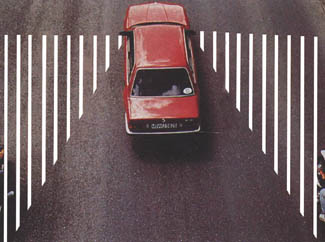
19. In this picture, the traffic lane(s) is/are:
20. Is the use of the seat belts necessary also for the passengers of the rear seats?
-
No, because they would be protected by the front seats.
-
No, because it is not prescribed by the Highway Code.
-
Yes, because otherwise they would not be protected in case of an accident.
21. You are driving having engaged the 4th gear, the engine is jerking and runs the risk of stopping:
-
You must change into the 5th gear.
-
You must change into the 3rd gear.
22. If you compare the steering-wheel with the numbered screen of a clock with hands, the correct position of the driver’s hands when driving straight is at:
-
A quarter past nine to ten past ten.
-
Nine.
-
Five past eleven.
23. While you are waiting for the green traffic light:
-
You must have engaged the 1st gear and be pressing the clutch pedal.
-
You must have put the gear in the neutral and be pressing the footbrake pedal.
-
You must have put the gear in the neutral and be pressing the clutch pedal.
24. In which cases must you use the direction indicators of your vehicle?
-
Only when you intend to change direction to the left.
-
Only when you intend to change lane or direction.
-
Before every change of direction or manoeuvre.
25. At a normal course where you do not need to change gears often, the left foot:
-
Should remain immobile on the left of the pedal.
-
Should remain on the clutch pedal without pressing it.
-
Should remain immobile opposite to the pedal.
26. How can you carry a small child in your passenger car as safe as possible?
-
On the rear seat, on a child seat of an approved type.
-
On the co-driver’s seat.
-
In the arms of a person sitting on the front seat.
27. What may happen if passengers sitting on the rear seats do not use the existing seat belts?
-
In a crash they create for the driver and co-driver an additional danger of injury.
-
Nothing, because the head restraints of the front seats offer sufficient protection against injuries.
28. At what distance must the full beam headlights of a car light sufficiently the road at night in good weather conditions?
29. What should the driver be careful about when using the mirrors of a passenger vehicle?
-
The interior mirror gives always full visibility to the right.
-
In a certain area (blind spot) cars that are overtaking may not be visible.
30. The sound coming from the horn of the vehicle must be:
-
Continuous on the same tone.
-
Piercing.
-
Alternating.